


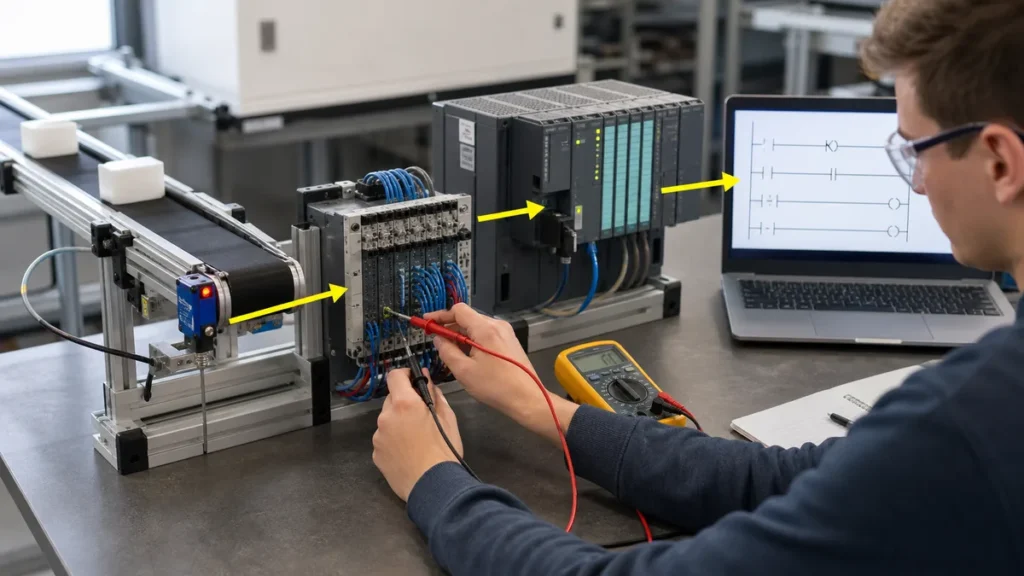
Manufacturing downtime costs companies an average of $50,000 per hour, with equipment failures accounting for 42% of unplanned stoppages. When a programmable logic controller (PLC) malfunctions on the production floor, every minute counts. Yet many facilities still rely on external contractors or a handful of overworked specialists to handle these critical repairs.
Smart manufacturers are discovering a more sustainable solution: investing in structured PLC Training for their maintenance crews. Rather than scrambling when systems fail, these companies build internal expertise that pays dividends through faster response times, reduced contractor fees, and proactive problem-solving capabilities.
This shift from reactive to proactive maintenance represents more than a training initiative. It fundamentally transforms how manufacturing facilities benefit from sending their teams to acquire specialized skills that directly impact the bottom line.
Immediate Cost Savings Through Reduced Contractor Dependency
Manufacturing facilities typically spend between $75,000 and $200,000 annually on external PLC contractors. These specialists charge premium rates—often $150 to $300 per hour—and may not be immediately available during critical breakdowns. A single emergency call-out during third shift can cost $5,000 before any actual repair work begins.
Training internal maintenance crews eliminates much of this expense. After completing structured coursework, technicians can handle 70-80% of PLC-related issues that previously required outside help. One automotive parts manufacturer reported saving $140,000 in the first year after training six maintenance technicians, simply by reducing contractor calls from twice weekly to twice monthly.
The financial impact extends beyond hourly rates. External contractors require facility orientation, safety briefings, and supervision—all consuming valuable production time. Internal staff already know the equipment, safety protocols, and production priorities. They can begin troubleshooting immediately without the administrative overhead that accompanies every contractor visit.
Dramatic Reduction in Equipment Downtime
Faster Diagnostic Capabilities
Trained maintenance crews diagnose PLC problems three to four times faster than untrained personnel. They understand error codes, recognize common failure patterns, and know which diagnostic tools to deploy first. This expertise transforms a four-hour troubleshooting marathon into a focused 45-minute repair.
Consider a typical scenario: a conveyor system stops unexpectedly. An untrained technician might spend hours checking mechanical components, testing motors, and examining sensors. A PLC-trained technician immediately checks the controller’s diagnostic LEDs, reviews the ladder logic, and identifies a failed input module within minutes.
Proactive Problem Prevention
Structured training teaches maintenance crews to spot warning signs before failures occur. They learn to monitor scan times, check battery voltages, and recognize when memory usage approaches critical thresholds. This predictive capability allows scheduled maintenance during planned downtime rather than emergency repairs during production runs.
Enhanced Safety and Compliance Standards
PLC-controlled safety systems protect workers from hazardous machinery. When these systems malfunction, production must stop until repairs ensure safe operation. Maintenance crews with formal training understand safety circuit requirements, lockout/tagout integration, and emergency stop configurations.
Regulatory compliance becomes simpler when internal staff understand PLC programming standards. They can modify safety interlocks, update alarm parameters, and document changes according to industry regulations. This capability proves especially valuable during safety audits or when implementing new OSHA requirements.
Insurance companies increasingly recognize the value of trained maintenance staff. Some providers offer premium reductions of 5-15% for facilities that document comprehensive Allen-Bradley PLC Training programs for their technical personnel. These savings compound the direct financial benefits of reduced downtime and contractor costs.
Improved Equipment Lifespan and Performance
Optimized Programming Reduces Wear
Trained technicians identify inefficient programming that causes unnecessary equipment stress. They recognize when PLCs command excessive acceleration rates, create mechanical conflicts, or cycle components beyond design specifications. By optimizing control logic, they extend equipment life by 20-30% while maintaining or improving production rates.
A food processing plant discovered their mixing equipment was failing prematurely due to aggressive ramping parameters in the PLC program. Their newly trained maintenance team adjusted the acceleration curves, reducing motor replacements from quarterly to annually while maintaining the same production throughput.
Better Integration of New Equipment
Modern manufacturing requires frequent equipment upgrades and production line modifications. Maintenance crews with PLC expertise can integrate new machinery without extensive contractor support. They understand communication protocols, configure I/O modules, and modify existing programs to accommodate new equipment.
This self-sufficiency accelerates implementation timelines. Projects that previously required six weeks of contractor scheduling and programming can be completed in two weeks by trained internal staff. Faster implementation means quicker return on investment for new equipment purchases.
Building a Culture of Continuous Improvement
Structured training programs create a foundation for ongoing skill development. Technicians who complete formal courses gain confidence to explore advanced features, experiment with optimization strategies, and share knowledge with colleagues.
This cultural shift manifests in tangible ways. Maintenance crews begin suggesting process improvements based on their understanding of control capabilities. They collaborate more effectively with engineering teams. They document solutions and create internal knowledge bases that benefit the entire organization.
Cross-training becomes more effective when built on a structured foundation. Technicians with formal PLC training can mentor newer employees, creating a sustainable pipeline of skilled personnel. This internal development path improves retention rates and reduces recruiting costs for specialized positions.
Frequently Asked Questions
How long does structured PLC training typically take?
Comprehensive PLC training programs range from 3-5 days for basic courses to 2-3 weeks for advanced certification paths. Most facilities see immediate benefits after technicians complete a one-week foundational course covering ladder logic, troubleshooting techniques, and common hardware platforms.
What’s the typical ROI timeline for PLC training investments?
Manufacturing facilities generally recover training costs within 3-6 months through reduced contractor expenses and decreased downtime. A single prevented breakdown during peak production can offset the entire training investment for multiple technicians.
Should all maintenance technicians receive PLC training?
Not necessarily. Facilities typically train 30-50% of their maintenance crew, focusing on technicians who show aptitude for controls work and those assigned to critical production areas. This creates a core group of specialists while maintaining cost efficiency.
Can online PLC training be as effective as in-person instruction?
Hands-on practice with actual PLC hardware remains crucial for developing troubleshooting skills. While online courses provide valuable theoretical knowledge, the most effective programs combine online learning with in-person lab exercises using real controllers and simulation software.
How often should PLC training be updated or refreshed?
Technology evolution and staff turnover necessitate ongoing training initiatives. Annual refresher courses help technicians stay current with software updates and new features. Major platform changes or equipment upgrades may require additional targeted training sessions.
What prerequisites should maintenance technicians have before PLC training?
Basic electrical knowledge and computer literacy form the foundation for successful PLC training. Technicians should understand electrical circuits, digital logic concepts, and basic computer operations. Experience with industrial equipment provides helpful context but isn’t mandatory.
Conclusion
The evidence overwhelmingly demonstrates how manufacturing facilities benefit from sending maintenance crews to structured PLC training programs. The investment yields immediate returns through reduced contractor costs and minimized downtime while building long-term advantages in safety, equipment optimization, and operational flexibility. Facilities that commit to comprehensive training transform their maintenance departments from reactive repair services into proactive reliability partners.
Forward-thinking manufacturers recognize that PLC expertise represents a competitive advantage in an increasingly automated industry. As production systems grow more complex and interconnected, the facilities with strong internal technical capabilities will adapt faster, operate more efficiently, and capture greater market opportunities. The question isn’t whether to invest in PLC training, but how quickly to begin building these critical competencies.